
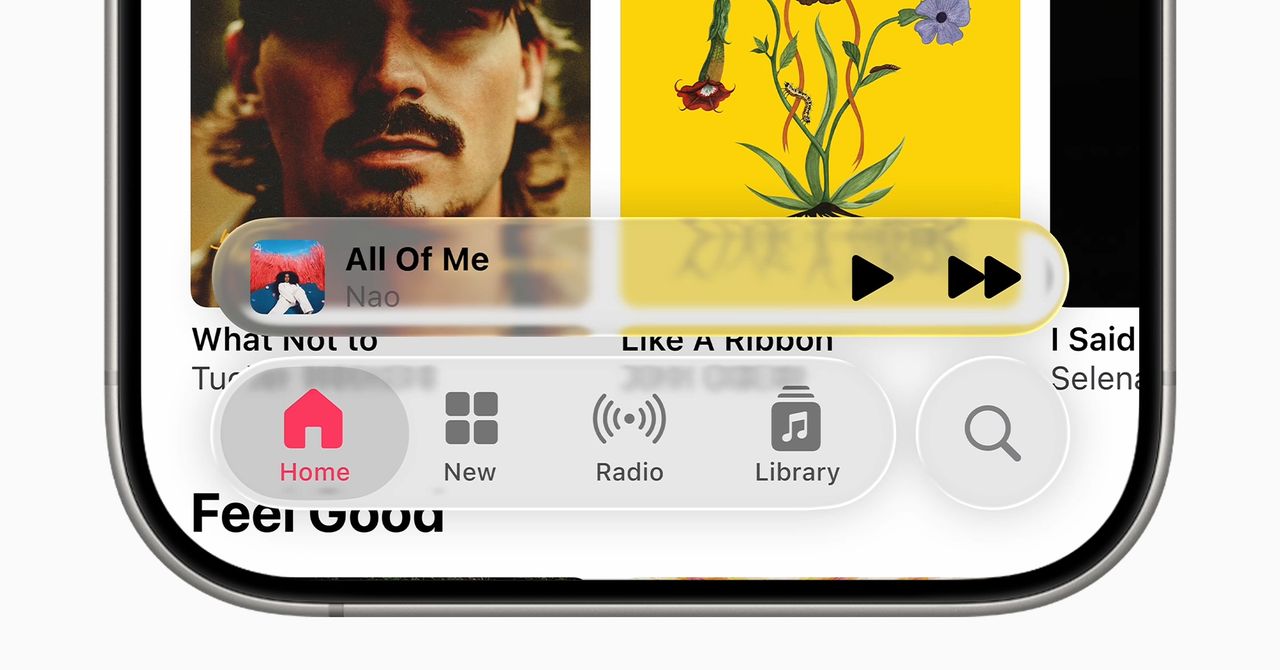
Liquid Glass Could Be One of Apple’s Most Divisive System Designs Yet Leave a comment
Apple revealed Liquid Glass as a part of its WWDC announcement this June, with all of the pomp normally reserved for shiny new gear. The press launch promised a “pleasant and chic new software program design” that “displays and refracts its environment whereas dynamically reworking to convey larger focus to content material.” As we speak it launches globally onto compatible Apple devices.
If you happen to haven’t encountered it but, brace your self. Impressed by visionOS—the software program powering the Apple Imaginative and prescient Professional blended actuality headset—Liquid Glass infuses each Apple platform with a layered glass aesthetic. That is paired with gloopy animations and a fixation on hiding interface parts when attainable—and displaying content material by means of them when it isn’t.
The response in the course of the summer season’s public beta program was divisive. And whereas some individuals simply hate change, Liquid Glass does invite criticism. As a substitute of sharpening focus, it too typically muddies it because of legibility points and distracting visible results. On Mac, controls are overly distinguished, but on iPhone, they’re relentlessly wanting to disappear into a brand new Apple tackle hamburger menus, denying customers the possibility to construct efficient muscle reminiscence.
At instances, Apple even verges on parody. Its press launch talked of “establishing larger concord between {hardware}, software program, and content material,” which in observe typically means additional blurring the road between interface and content material and slapping enormous rounded corners that echo the iPad’s display onto each Mac and iPad window. The consequence: chopped-off content material and a baffling disregard for extra standard rectangles, probably the most environment friendly form within the historical past of multi-window computing.
Fashion Over Substance?
Jonas Downey, designer of Hiya Climate, doesn’t solely purchase Apple’s pitch: “I dig Apple and peculiar flashy stuff and am impressed with numerous execution particulars within the glass idea. However the brand new interfaces really feel sophisticated and overbearing, with Apple imposing its personal aesthetic concepts on everybody else. I might get on board if there was an apparent profit,” he provides, “however I haven’t seen one past the previous adage that person interfaces ought to get out of the best way of content material. That’s a nice precept, however Liquid Glass too typically does the alternative.”
He reels off an inventory of points. Translucent parts inflicting distraction. Low distinction making it tougher to distinguish components. Extra shading and dimension on buttons and tabs making them pop greater than the content material beneath them. This, he says, may end up in friction slightly than focus. “Liquid Glass splits the distinction between flat and skeuomorphic design, touchdown in a fragile center area,” he concludes. “By making an attempt to develop into extra floaty and deconstructed, the system finally ends up extra visually advanced.”
For Ben McCarthy, creator of Obscura Camera, there’s at the very least promise within the “Liquid” a part of the equation: “Dynamic Island was praised for its fluidity—the way it expanded and contracted like viscous ink. Liquid Glass appears born of comparable considering, in that animations ought to be enjoyable, dynamic, and rooted in materials behaviors—and that side is vastly profitable.”
The “Glass” half, although? Not a lot. “Apple’s purpose is to mix interface and content material to scale back distraction, however I feel Liquid Glass achieves the alternative,” McCarthy says. “It creates distortions that catch your eye as content material scrolls. There are basic legibility points, as a result of Liquid Glass can’t management what passes behind it. And because the system tries to adapt, flipping between gentle and darkish to remain readable, that solely additional provides to the distraction.”
