
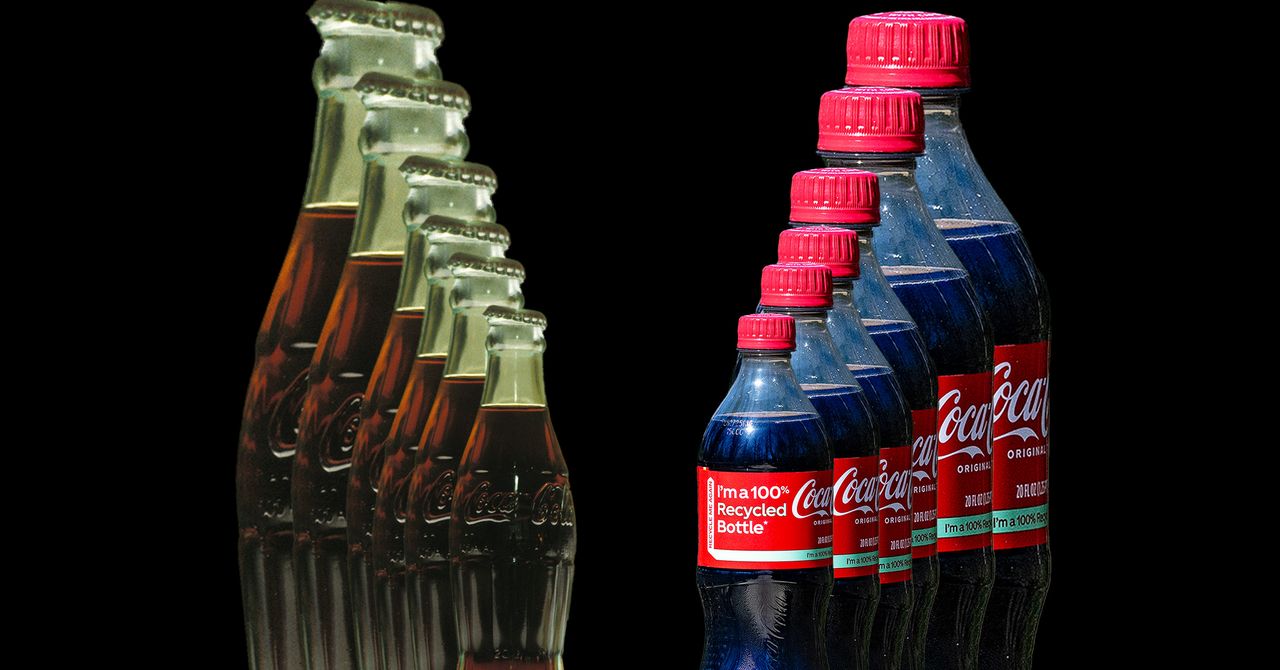
Coke Designed a Plastic Bottle to Sell Us All More Soda Leave a comment
McWhorter polled customers, who indicated that they’d desire contour bottles over straight-walled ones by a margin of 5 to at least one.
Youthful customers noticed the bottle as trendy and totally different, whereas older individuals who remembered the form related it with high quality. Client curiosity confirmed, Ivester needed not only a plastic reproduction of the glass bottle, however a a lot bigger model. Over time, Coke had steadily elevated the sizes of its fountain drinks. A big soda now stood at 20 ounces, a full 4 ounces greater than the earlier iteration. “We had been actually coaching customers at the moment to drink increasingly,” says McWhorter.
Coke didn’t must cost customers far more as a result of the revenue margin on fountain soda was a lot increased than on bottles and cans. The massive fountain sodas paved the way in which for the corporate to slowly however certainly reshape shopper expectations, making a thirst amongst People for bigger quantities of soda, throughout each packaging kind.
“The customers simply ordered a big,” explains McWhorter. “They didn’t know whether or not it had 16 ounces or 20 ounces in it. For us, the considering was, ‘We promote extra, we make extra, so let’s measurement up.’”
Ivester instructed McWhorter to discover a solution to make a 20-ounce plastic bottle that regarded like the unique 6.5-ounce glass one with out compromising the design’s integrity.
However sizing up was trying costly. For one factor, the bottle producers wanted to make use of additional plastic to provide the curvy bottle added reinforcement. Curvy bottles additionally couldn’t be blown as rapidly as straight ones. The bottles wobbled on filling traces. Bottlers trialling them pumped in simply 10 % of the liquid they normally crammed in a day. Modifying the filling gear might value a bottler between $1 million and $2 million. But the payoffs had been unsure, and Coke’s latest monitor file was something however reassuring.
Ivester had solely just lately pushed bottlers to get behind a transparent, sugar-free soda meant to compete with a transparent, colorless Pepsi. Coke referred to as it Tab Clear and Ivester informed reporters the product can be “marketed for what it’s: a research in contradictions.” However the advertising confused folks. They didn’t recall the adverts. The important thing message—that Tab Clear had a “mysterious taste”—didn’t resonate. Tab Clear’s many critics stated it regarded like lemonade however tasted like weak cola. By late 1993, a couple of 12 months after Tab Clear’s launch, Goizueta was hinting that the product was lifeless.
“We had been going into an setting the place bottlers stated, ‘Yeah, we’ve seen all this analysis from the corporate on how nice issues are going to be. We’ve finished all this work, however it doesn’t repay,’” says McWhorter.
To win over the bottlers, Ivester knew he wanted to place his cash the place his mouth was. “Coke will mortgage you the cash for the conversion of your traces,” he informed them. “When you execute the advertising plan Susan and her crew provide you with and don’t meet the goal numbers, I’ll forgive these loans.”
Ivester was taking a chance. Coca-Cola was ploughing tens of tens of millions of {dollars} into modifying the bottlers’ traces, which meant the quantity of soda it offered wanted to leap considerably to cowl the added prices.
In January 1993, Coke launched the plastic contour bottle in take a look at markets in Alabama and Tennessee. Gross sales jumped 25 %. “For greater than 75 years, our contour bottle design has been the unparalleled image of high quality,” Ivester stated when saying the launch. “The brand new 20-ounce bundle preserves that heritage whereas providing the comfort of a recyclable plastic bundle to right this moment’s shopper.” The plastic contour bottle, the corporate informed traders, will “invite customers to drink extra Coca-Cola, extra usually and in bigger sizes.”
The Wall Road Journal dismissed the bottle as a “advertising gimmick,” in an article titled “New 20-Ounce, Plastic Model Is Making an attempt to Be Nostalgic and Hip on the Identical Time.” Unsurprisingly, Pepsi denigrated the bottle, telling the Journal: “The extra nostalgic Coke will get, the extra Pepsi appears to be like progressive, from a picture standpoint.”
