
Sony’s Dazzling New RGB LED TV Comes in 2026 Leave a comment
We then bought to see the absolutely assembled RGB prototype subsequent to Sony’s greatest conventional mini-LED TV, the Bravia 9 (9/10, WIRED Recommends), and its 2023 flagship OLED, the A95L (9/10, WIRED Recommends), and once more the outcomes have been spectacular.
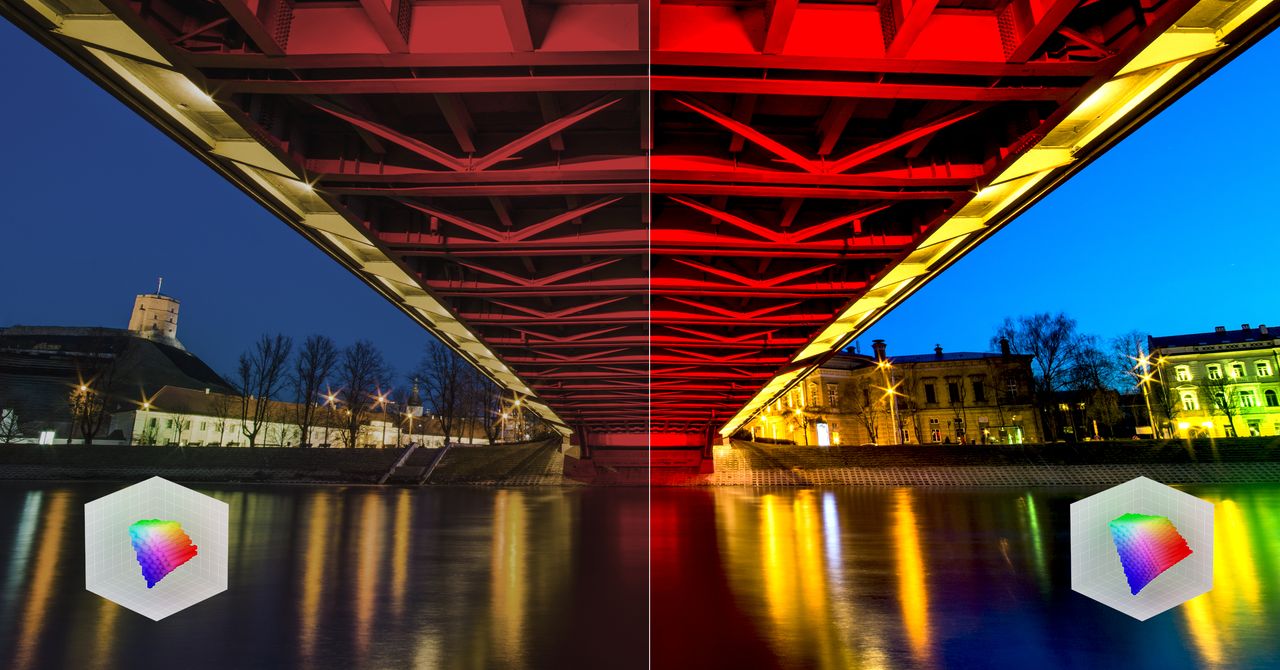
Whereas the prototype wasn’t in a position to create the identical good black ranges and centered distinction of the OLED mannequin, it had strikingly efficient blooming management and picture focus. Its colours appeared richer and extra saturated than each TVs, and its brightness simply outdid even the Bravia 9, one of the crucial fiery TVs in its class. Sony says the show can produce 99 p.c of the baseline DCI-P3 colour spectrum, and 90 p.c of the extra superior BT.2020 spectrum, each main feats. Simply as intriguing is the show’s claimed stage of colour management at low brightness, designed to enhance accuracy over present shows in dimly lit scenes.
Courtesy of Sony
Apparently, this isn’t the primary RGB LED show in Sony’s 60-plus-year TV catalog. Sony launched a now archaic model of RGB LED tech in 2004, although that model can hardly be in comparison with at this time’s shows. The most effective mini-LED TVs comprise 1000’s of lights and a whole bunch of dimming zones for significantly better brightness, accuracy, and precision than within the early days.
Nonetheless, as placing as these newest RGB mini-LEDs are, they are not almost as tiny because the tens of millions of pixels that make up 4K TVs, to allow them to’t come near creating the exact colour gradations required for the billion-plus colours trendy TVs can show on their very own. Because the engineers demonstrated, the RGB prototype makes use of colour filters, Sony’s proprietary XR Shade Booster, and different applied sciences to supply the ultimate product.
This necessitates a hand-off between the tri-colored backlights and the remainder of the panel, all of which have to be coordinated by a TV’s processors. In keeping with Sony, that is on the coronary heart of what units its RGB TV’s efficiency aside from different manufacturers. That’s a part of what makes the Japanese model’s entry into the RGB TV horse race so intriguing.
A Nice View From Any Angle
Sony laid out a number of methods its RGB shows outdo at this time’s greatest LED TVs throughout my time in Japan. The flexibility to create subtractive colours between the backlights and the colour filters helps result in larger effectivity for improved brightness, doubtlessly equating to Sony’s famend skilled screens. The shortage of white gentle behind the panel reduces gentle spillage and permits for extra centered colours, for higher blooming management, and the creation of colours on the gentle supply permits for a better bit-depth in colour gradation and higher saturation than conventional LED shows. This implies richer and extra correct colour replica.
Perhaps probably the most compelling trait of RGB LED TVs is their improved off-axis efficiency for while you’re not viewing head-on. The prototype’s brightness and colours appeared glorious for an LED TV when stepping to the facet, one thing Sony says is because of each the brand new show’s cell construction in addition to its superior management over colour gradation.
