
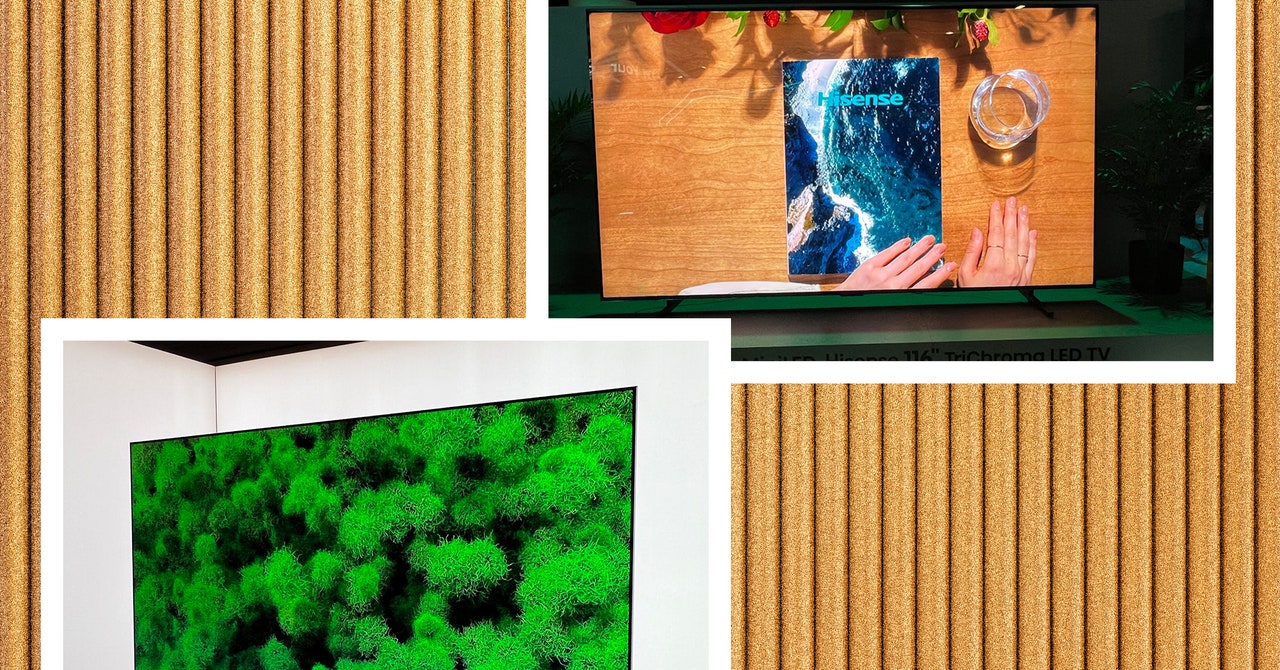
Hisense’s RGB LED Could Be the Future for Cheap Screens Leave a comment
Hisense didn’t deliver many TVs to CES 2025, however what did make the journey could be an indication of the way forward for show expertise.
The model’s 116-inch RGB LED TV, dubbed the UX Trichroma TV, makes use of a brand new form of LED lighting system with the potential to shake up the market. The system can’t flip every tiny pixel on or off like OLED or MicroLED, nevertheless it provides equally placing distinction alongside unimaginable brightness, unbelievable accuracy, and different intriguing advantages. The key behind its brilliance is within the colours.
What Is RGB LED?
It is all about backlighting. Conventional LED TVs fight gentle spillage round vivid objects on darkish backgrounds through the use of a number of dimming zones (referred to as native dimming) and 1000’s of more and more small LEDs. But, even the perfect LED TVs will produce some noticeable gentle bleed (or haloing) round vivid pictures, whereas offering much less placing distinction than emissive gentle sources that present a wonderfully black backdrop like OLED and MicroLED, the place every pixel is its personal backlight.
Not like conventional LEDs, which produce a white or blue gentle after which run that via colour filters, Hisense’s new RGB LED panel makes use of 1000’s of optical lenses, every containing purple, inexperienced, and blue LEDs to provide “pure colours immediately on the supply.” In line with Hisense, this leads to the “widest colour gamut ever achieved in a MiniLED show.” The TV is claimed to provide 97 p.c of the BT.2020 colour house, probably the most expansive show colour commonplace obtainable. The tech supplies different efficiency benefits too.
As a result of its RGB panel produces colours on the gentle supply, RGB LED can get fantastically vivid whereas providing enhanced backlight management and vastly cut back gentle bleed. Hisense calls this system “RGB native dimming,” versus custom LED-based native dimming, the place the backlight of an LED TV consists of zones of LEDs for higher distinction however nonetheless inevitably has gentle bleed.
In principle—and within the temporary time I spent with the Trichroma TV at CES—Hisense’s RGB tech supplies deeper black ranges and higher distinction alongside extra expansive colours than present LED TVs, even giving OLED and MicroLED a run for the cash.
RGB vs. OLED: The Brightness Wars of 2025
It’s arduous to beat OLED TVs for sheer image efficiency proper now. OLED’s mix of good black ranges, near-infinite distinction, glorious off-axis viewing, and expansive colours powers the perfect TVs you should purchase. But for all its benefits, OLED has its limitations—specifically, brightness ranges that may’t match probably the most potent LED TVs.
That may sound dismissive contemplating the perfect OLED TVs are already searingly vivid in a vacuum. Flagships like Panasonic’s Z95A (9/10, WIRED Recommends), LG’s G4, and Samsung’s S95D (8/10, WIRED Recommends) all get remarkably near 2,000 nits peak brightness, outshining the brightest LED TVs from only a few years again. An improve for 2025 may probably push the most recent fashions previous that 2,000 nit milestone. In reality, the most recent panels from Samsung and LG Show declare to get as vivid as 4,000 nits in very small home windows (although this appears unlikely to translate in real-world content material).
